The station in space
 The European Space Agency (aka the Agence
Spatiale Europeene)(ESA), NASA, Russia, Canada and Japan, are the constructors
of the International Space Station (ISS), the largest space station science and
technology venture ever undertaken. On completion the new space station will be
the most sophisticated laboratory ever in space from Earth, with a permanent
international manned presence. ISS construction started in space at the end of
last year and it is due for completion by the end of 2003. Finished, the
station will comprise 420 tonnes of space lab and external attachments for
scientific research, both pure and applied as well as technology. At the same
time the station will be a test-bed for all manner of developmental work on
space necessary systems such as closed-loop life support as well as mundanities
as effective storage systems. There will be long term commercial exploitation
as well, so that research will not just be pure (for its own sake) but applied.
There may well be specialised manufacture even, to take advantage of the
sustainable lowgravity environment. For the crew the important aspects will be
the effects and difficulties of long term space residence and adaptation (and
return to Earth problems). Of especial interest is the planned link-up with
academic institutions so that both educators and their students will be able to
learn and participate via the Internet. Thus it is arguable that ISS will mark
the transition from space race and only for the elite few to colonisation and
broadbased accessibility for the universe beyond our planet. That it comes into
being as we cross the millenium is fortuitously memorable.
The European Space Agency (aka the Agence
Spatiale Europeene)(ESA), NASA, Russia, Canada and Japan, are the constructors
of the International Space Station (ISS), the largest space station science and
technology venture ever undertaken. On completion the new space station will be
the most sophisticated laboratory ever in space from Earth, with a permanent
international manned presence. ISS construction started in space at the end of
last year and it is due for completion by the end of 2003. Finished, the
station will comprise 420 tonnes of space lab and external attachments for
scientific research, both pure and applied as well as technology. At the same
time the station will be a test-bed for all manner of developmental work on
space necessary systems such as closed-loop life support as well as mundanities
as effective storage systems. There will be long term commercial exploitation
as well, so that research will not just be pure (for its own sake) but applied.
There may well be specialised manufacture even, to take advantage of the
sustainable lowgravity environment. For the crew the important aspects will be
the effects and difficulties of long term space residence and adaptation (and
return to Earth problems). Of especial interest is the planned link-up with
academic institutions so that both educators and their students will be able to
learn and participate via the Internet. Thus it is arguable that ISS will mark
the transition from space race and only for the elite few to colonisation and
broadbased accessibility for the universe beyond our planet. That it comes into
being as we cross the millenium is fortuitously memorable.
Education
 NASA's Pathfinder mission to Mars in 1997
was the first near-interactive space mission. The agency's new willingness to
open up access to its workings by allowing anyone on the net to access live
pictures from Mars proved irresistible to millions. The access was backed up
with well thought out illustrations and clear explanations, so that all could
follow what was happening and understand the science and technology involved.
With the station it will be possible to observe selected experiments with
explanations and educational input from experts. Additionally schools, colleges
and universities will be able to access and even input experiments. This will
be feasible because of the ease of access thanks to new technology, so that
experiments may well be performable at very low cost. As a start-up to the
educational programme, ESA is running a SUCCESS competition, for senior
students. They may propose experiments for the station, with prizes of
internships and thesis opportunities. The winning entries will be considered
for actual flight. The results will be announced in October 1999 and details
are on http://www.international-space-station.de/.
NASA's Pathfinder mission to Mars in 1997
was the first near-interactive space mission. The agency's new willingness to
open up access to its workings by allowing anyone on the net to access live
pictures from Mars proved irresistible to millions. The access was backed up
with well thought out illustrations and clear explanations, so that all could
follow what was happening and understand the science and technology involved.
With the station it will be possible to observe selected experiments with
explanations and educational input from experts. Additionally schools, colleges
and universities will be able to access and even input experiments. This will
be feasible because of the ease of access thanks to new technology, so that
experiments may well be performable at very low cost. As a start-up to the
educational programme, ESA is running a SUCCESS competition, for senior
students. They may propose experiments for the station, with prizes of
internships and thesis opportunities. The winning entries will be considered
for actual flight. The results will be announced in October 1999 and details
are on http://www.international-space-station.de/.
Living and working in space
 Up to seven astronauts at any one time will
live and work aboard the ISS, once it is completed in 2003, often for extended
tours of duty. Time in space, or even in the microgravity environment of Earth
orbit brings with it many physical and psychological hurdles which each must
overcome. The human body has been designed to operate at a force of 1g or very
close to that figure and any departure from this, whether flying fast jets
(when both positive and negative g forces can be experienced in quick
succession - and some pilots are able to withstand + or - 9 or even 10g) or in
microgravity, produces profound effects. In microgravity, as will be
experienced aboard the station, the first effect generally perceived is nausea,
caused by the general disorientation of a body in an environment with no
familiar 'up' and 'down'. There is no weight perception, only inertial
reaction; and balance is disturbed as it relies on gravity. The sense of touch
is also altered. Mental pressure comes from being confined closely in a
high-risk environment for long periods with other people, working at high
pressure and under a need for constant vigilance. Much research will be
possible, backing up data obtained mostly from Mir, on microgravity effects not
only on the sensory systems of the human body but also on blood circulation,
lung performance, fluid distribution and electrolyte balance which all modify.
Research is also planned into the effects of microgravity on the body even at
the cellular level since changes are perceived even this far down. It is well
known that bone density is altered, as prolonged stays in space cause
progressive deterioration as bone cell resorption occurs, so that astronauts
suffer an effect very like age-induced osteoporosis. Aboard Mir, astronauts
lost bonemass at the rate of 1% per month from the lower spine, hips and legs.
There was also significant loss of muscle density and tone. Such a significant
degredation would tend to rule out prolonged space exposure, such as would be
endured on a Mars mission, until it can be satisfactorily combatted. At the
same time calcium levels in the astronauts blood rises, which may lead to
kidney stones and the calcification of soft tissue. Research into cause and
prevention may help the millions of clinical sufferers in to this major cause
of disablement and death in old age, as well as in treating the bed-ridden.
Loss of the pull of gravity affects the functioning of the heart and
circulatory system since there is no longer such a need to 'push' against its
effects and the lungs feel the effect through changes to chest wall mechanics.
(This results particularly in sleep disturbances). Even with a crew picked for
physical health, emergencies will be inevitable, and to support coping with
such contingencies the ISS bodies are developing a range of health analysis and
support systems for both routine and emergency procedures, based on novel
medical information systems, computer diagnostic and virtual reality clinical
guidances. These techniques are already cascading down into improvements in
imaging and diagnosing for Earth-based healthcare.
Up to seven astronauts at any one time will
live and work aboard the ISS, once it is completed in 2003, often for extended
tours of duty. Time in space, or even in the microgravity environment of Earth
orbit brings with it many physical and psychological hurdles which each must
overcome. The human body has been designed to operate at a force of 1g or very
close to that figure and any departure from this, whether flying fast jets
(when both positive and negative g forces can be experienced in quick
succession - and some pilots are able to withstand + or - 9 or even 10g) or in
microgravity, produces profound effects. In microgravity, as will be
experienced aboard the station, the first effect generally perceived is nausea,
caused by the general disorientation of a body in an environment with no
familiar 'up' and 'down'. There is no weight perception, only inertial
reaction; and balance is disturbed as it relies on gravity. The sense of touch
is also altered. Mental pressure comes from being confined closely in a
high-risk environment for long periods with other people, working at high
pressure and under a need for constant vigilance. Much research will be
possible, backing up data obtained mostly from Mir, on microgravity effects not
only on the sensory systems of the human body but also on blood circulation,
lung performance, fluid distribution and electrolyte balance which all modify.
Research is also planned into the effects of microgravity on the body even at
the cellular level since changes are perceived even this far down. It is well
known that bone density is altered, as prolonged stays in space cause
progressive deterioration as bone cell resorption occurs, so that astronauts
suffer an effect very like age-induced osteoporosis. Aboard Mir, astronauts
lost bonemass at the rate of 1% per month from the lower spine, hips and legs.
There was also significant loss of muscle density and tone. Such a significant
degredation would tend to rule out prolonged space exposure, such as would be
endured on a Mars mission, until it can be satisfactorily combatted. At the
same time calcium levels in the astronauts blood rises, which may lead to
kidney stones and the calcification of soft tissue. Research into cause and
prevention may help the millions of clinical sufferers in to this major cause
of disablement and death in old age, as well as in treating the bed-ridden.
Loss of the pull of gravity affects the functioning of the heart and
circulatory system since there is no longer such a need to 'push' against its
effects and the lungs feel the effect through changes to chest wall mechanics.
(This results particularly in sleep disturbances). Even with a crew picked for
physical health, emergencies will be inevitable, and to support coping with
such contingencies the ISS bodies are developing a range of health analysis and
support systems for both routine and emergency procedures, based on novel
medical information systems, computer diagnostic and virtual reality clinical
guidances. These techniques are already cascading down into improvements in
imaging and diagnosing for Earth-based healthcare.
Commerce
 The ISS will serve as a fixed base test bed
for many potential commercial applications as well as research packages. Its
big advantage is not simply that it is big and there, but that maintenance,
either routine or repair can be very easily performed, even if the package is
mounted outside. For example, one of the first experimental applications is the
technology exposure facility, which will test superconductor systems destined
for satellite communications. These systems will provide power saving and
enhanced performance. The module will also be testing electric propulsion for
communications systems for orbital transfer manoeuvering, station keeping and
attitude control.
The ISS will serve as a fixed base test bed
for many potential commercial applications as well as research packages. Its
big advantage is not simply that it is big and there, but that maintenance,
either routine or repair can be very easily performed, even if the package is
mounted outside. For example, one of the first experimental applications is the
technology exposure facility, which will test superconductor systems destined
for satellite communications. These systems will provide power saving and
enhanced performance. The module will also be testing electric propulsion for
communications systems for orbital transfer manoeuvering, station keeping and
attitude control.
Time and space
According to the theory of general relativity, gravity is a
property of space-time. A French package will be using the microgravity of
orbit to provide meta-accurate time keeping. A huge body such as the sun
modifies local space by its presence, leading to a bending of light as it
passes by the star. The light is also retarded and there is a frequency shift.
At present the most efficient clock is a cooled atomic clock, in which caesium
atoms are cooled to about 1k by a laser system. Then a microwave frequency is
locked into the extremely narrow resonance frequency of the cold atoms and the
accuracy comes from measuring the length of time that an atom can interact with
the microwave field. On Earth, gravity causes the atoms to increase their speed
rapidly when the lasers are switched off for signal interrogation, but by
moving the clock assembly into microgravity it is expected that the accuracy
will increase hugely. The French package will be including reference clocks and
microwave and laser links down to Earth to provide globally unprecedented
accuracy widely available. Other applications will include greater accuracy in
measuring long baseline radio interferometry observations and greater precision
in global navigation systems and geodesy measuring to millimetre precision.
 Pure research
The station will carry probes to examine cosmic dust and
cosmic rays, it will be able to search for and study gravitational waves, and
research for the background remnants of the Big Bang. The French time-keeping
package will allow new accuracy to be achieved in the study of the red shift in
astronomy and of the measurement of the accuracy of the bending of light by the
sun. An attempt to measure the weight of the anti-proton is to be made.
Collecting and studying some of the 'stuff' floating round in orbit may well
shed light on the origins of life on Earth, as it will be possible to search
for the building blocks among the debris of comets and other bodies. At the
same time it is likely that the station will be used to keep a sharp look out
for space bodies which may pose a threat to Earth.
Conclusion
Since the Apollo programme ended (and Neil Armstrong's
landing on the moon 30 years ago next month) man has not strayed beyond the
orbit of his home world. Research into the surmountable obstacles placed in the
path of solar system exploration will be accelerated and enhanced by the work
planned for the ISS. W
We couldn't leave home without it.
 Update July 3 2000
New dates have been announced for the remaining 43 missions
required to build the International Space Station.
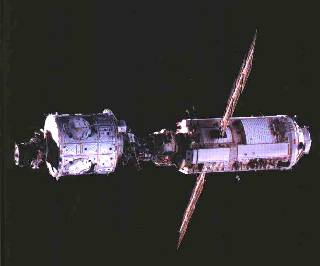
Two elements of the Station - the Russian-built Zarya
module and the US's Unity module - are already in orbit. The third element, the
Russian service module named Zvezda ("star" in Russian), will now be
launched in November from Baikonur, Kazakhstan. It is currently undergoing
testing at the Baikonur cosmodrome. Zvezda will serve as the crew living
quarters over the next four years while the Station is being assembled.
The module will be equipped with the first piece of
European hardware on the Station, an ESA-developed onboard computer that will
act as Zvezda's brain Zvezda will also carry the antenna for the European
Global Time System, the first experiment on the Station. It will broadcast
experimental chronometric signals whose proposed uses range from automatic
adjustment of clocks and watches between time zones to remote immobilisation of
stolen vehicles. The Columbus laboratory, Europe's main contribution to the
Station, is now scheduled for launch on board the US Space Shuttle in February
2004, Another key European system, the European Robotic Arm, built for the
Russian Science and Power Platform, is set to be launched in November 2001. The
10-metre arm will be used to assemble the Russian segment of the Station. It is
currently undergoing flight qualification.
The first European, ESA astronaut Umberto Guidoni, is now
scheduled to set foot on the Station in June 2000. His Space Shuttle crew will
deliver up to 10 tons of equipment, experiments and supplies to the Station,
transporting the material in a multipurpose logistics module developed by the
Italian space agency ASI.
'All Right' says Fred (Update May 2001)
 Fred is the unmentioned member
of the ISS crew, presently keeping his crew mates safe from radiation. Fred has
no arms. He has no legs.
Fred is the unmentioned member
of the ISS crew, presently keeping his crew mates safe from radiation. Fred has
no arms. He has no legs.
Fred is the Phantom Torso, a 95-pound, 3 foot high mock-up
of a human upper body. Beneath Fred's artificial skin are real bones and Fred's
organs -- the heart, brain, thyroid, colon and so on -- are made of a special
plastic that matches as closely as possible the density of human tissue.
The dummy is spending the next four months on board the ISS
to measure the radiation to which astronauts are exposed. High-energy particles
that pass through the human body can disrupt the way cells function. Although
no astronaut has ever been diagnosed with space radiation sickness, excessive
exposure could lead to health problems.
"We believe the current dose is too small to be of
concern," says Dr. Gautam Badhwar, the study's principal investigator at
the Johnson Space Centre. "The one possibility for radiation sickness
might be an EVA situation during a solar event, if perhaps a crew member
couldn't be brought back inside safely." But there's still lots to learn,
he added, and that's where Fred can help.
The Phantom Torso is designed to do three things, explains
Badhwar. First, it will determine the distribution of radiation doses inside
the human body at various tissues and organs. Second, it will provide a way to
correlate these doses to measurements made on the skin. "In the past we've
typically recorded doses only on the skin," explains Badhwar,
"whereas the risk to crew members is established by exposure to internal
organs." Finally, the Phantom will help check the accuracy of models that
predict how radiation moves through the body.
Astronauts are exposed to three types of radiation while in
space:
The most energetic are Galactic Cosmic Rays (GCRs) -- the
nuclei of atoms accelerated by supernova explosions outside our solar system.
Cosmic ray nuclei can be as light as hydrogen, as heavy as iron, or almost
anything in between. Because they lack their surrounding coat of
negatively-charged electrons, GCRs are positively charged. The heavier nuclei
carry the greatest charge, explains Badhwar. "As the charge increases, the
amount of energy that the particle can deposit in tissue increases as
well."
The other forms of particulate radiation consist mostly of
protons. Most high-energy protons in the solar system come from the Sun.
Although their charge is not great and they are less energetic than GCRs, solar
protons can still be dangerous when they come in intense bursts known as solar
flares.
The third kind of radiation, which surrounds Earth in areas
known as Van Allen belts, consist mostly of decayed products from galactic
cosmic ray interactions that have been trapped by Earth's magnetic field.
Some of this trapped radiation is confined to a region above
the coast of Brazil, known as the South Atlantic Anomaly. "The Space
Station goes through that Anomaly roughly five times a day," says Badhwar.
The passage takes, at most, 22 or 23 minutes. That's good, he says.
If you go through the trapped radiation belt in less than
twenty minutes or so, then for the next seventy minutes the body has time to do
some repair to the damage done by the radiation." The radiation from solar
flares can actually do more harm, he says, simply because it comes at a rate
that doesn't give the body time to recover.
In order to measure space radiation as it propagates through
Fred's body, Badhwar and his team have sliced Fred horizontally into 35
one-inch layers. In each section they've made holes for radiation detectors
called dosimeters. The torso carries 416 lithium-crystal based passive
dosimeters, which simply record the total radiation dose received throughout
the mission. Fred is also equipped with 5 active detectors. These, placed at
the Phantom's brain, thyroid, heart, colon, and stomach, can track the times
that the radiation exposures took place.
"With the active detectors, we can correlate the time
the radiation was received with the position of the spacecraft," explains
Badhwar. "We can separate out quite reliably when we were in the Anomaly
and when we were in the Galactic Cosmic Ray region." This kind of split
makes radiation models derived from such data applicable to interplanetary
missions, too. To assess astronaut exposure on a trip to Mars, for example,
"we'll just switch off the Van Allen Belt particles," says Badhwar.
Radiation models devised by Badhwar and colleagues will be
able to estimate how much radiation reaches an astronaut's internal organs
simply by looking at the dose on his or her skin. That's important, because
while the permissible radiation limits are based on internal exposures,
practically speaking, all that can be measured is what occurs on the skin.
Such models are also scalable. Rather than giving a blanket
risk assessment for all crew members, they can be customized to each individual
in terms of height, weight, and even personal histories: how the astronaut
flies an aircraft, or what medical tests he or she might have taken. All this
contributes, says Badhwar, to total radiation exposure.
Even our internal bacteria rate a careful look: If a crew
member gets too much radiation, it could kill the digestive bacteria essential
for breaking down food.
Space station crew members will be sending data from the
Phantom's five active dosimeters back to Earth about every ten days. When the
device returns to Earth next fall, Badhwar and his team will be able to examine
results from Fred's passive detectors as well.
"The thing that we're really going after is to get as
good a handle as we can on what the organ exposures really are." he says.
The goal is to make sure that the crew is exposed to the least amount of
radiation possible.
 Astronauts working on the
construction of the ISS now have a new tool to help them - a robotic arm built
for the station by the Canadian Space Agency (CSA)
Astronauts working on the
construction of the ISS now have a new tool to help them - a robotic arm built
for the station by the Canadian Space Agency (CSA)
Called Canadarm2 it is 'a bigger, smarter and more grown-up
version of the shuttle's robotic arm," said Chris Lorenz, CSA's manager of
mission operations. "It's part of Canada's investment in the space station
program." Weighing 1640 kg (3620 lb), Canadarm2 is 17.6 meters (57.7 feet)
long when fully extended and has seven motorized joints. It's capable of
handling large payloads and helping dock the space shuttle.
Canadarm2 is surely big and strong, but it's not just a
brute. This next-generation robotic arm has some amazing tricks up its sleeve..
Unlike the original Canadarm, which is mounted just outside a shuttle's payload
bay, Canadarm2 won't be tied down to one spot. Each end of the new arm has a
hand that can grasp an anchor on the space station. By flipping end-over-end
between anchor points, Canadarm2 can move around the ISS like an inchworm.
With seven joints, Canadarm2 is more maneuverable than its
predecessor on the shuttle and even more agile than a human arm. This is
important because the space station is a larger and more complex environment
than the shuttle's payload bay.
Once installed the station's crew will control Canadarm2
from two identical consoles (called "Robotic Workstations") located
inside the Destiny Lab. Eventually one of those workstations will move to The
Cupola -- a module tentatively scheduled for launch in 2005. Like the
window-studded "Ten Forward" lounge on Star Trek's USS Enterprise,
the Cupola --with eight windows-- will provide astronauts a stunning view of
the space around the ISS. It's the perfect spot for direct viewing of the
robotic arm and shuttle payload operations.
 The Canadian
Space Agency has also built a ground control center for Canadarm2 at the CSA's
Saint-Hubert, Quebec, headquarters. That facility is linked directly to NASA's
Mission Control at the Johnson Space Center in Houston, Texas. Crewmembers on
board the ISS will be the ones who actually control the arm. Personnel in
Quebec and Houston will offer real-time support and troubleshooting while
Canadarm2 operations are underway in space. The Canadian
Space Agency has also built a ground control center for Canadarm2 at the CSA's
Saint-Hubert, Quebec, headquarters. That facility is linked directly to NASA's
Mission Control at the Johnson Space Center in Houston, Texas. Crewmembers on
board the ISS will be the ones who actually control the arm. Personnel in
Quebec and Houston will offer real-time support and troubleshooting while
Canadarm2 operations are underway in space.
Canadarm2 is only the first instalment of what the CSA
refers to as the space station's "Mobile Servicing System." The next
piece (slated for launch no earlier than 2002) will be the Mobile Base System,
or MBS -- literally a small truck that moves along rails covering the exterior
of the ISS.
|
Plumbing in space
While the basics of human hygiene in space have been solved
for many years a more ..civilised approach had to be created for astronauts who
would be spending long times aboard the ISS.
Designers of the International Space Station (ISS) had to
lay out a complex network of tubes, pipes and ducts between the Station's outer
skin and its inner walls. Like veins and arteries in the human body, the
Station's plumbing circulates vital liquids and gases that keep the crew and
the ISS itself in good health.
Most of the time the ISS -- and its plumbing -- operates as
a "ship in a bottle," cut off from the outside world. Between
replenishment visits, the Station runs on a fixed amount of air and water.
Efficient, leak-free recycling of everything that flows through the pipes is
essential.
"This is kind of an ecologist's dream house," said
Dave Williams, system manager for Environmental Control and Life Support
Systems (ECLSS) at Johnson Space Center in Houston, Texas. "If you built a
house this way you would be reclaiming as much water as possible."
For example, while a house on Earth can simply drain its
wastewater to lines leading to a municipal treatment plant, the ISS must carry
its own
miniature water treatment plant onboard.
This equipment must achieve a higher level of cleanliness
than its earthly counterparts for several reasons. Unlike most municipal
systems, the ISS system recycles the urine of both the crew and the laboratory
animals and returns it to the drinking water supply
Microbes are a danger even to the Station itself, as
exemplified by the problems on Mir with fungal growth. Keeping microbe levels
in the water supply to an absolute minimum is an important part of ensuring the
longevity of the Station.
Operating "in a bottle" also complicates the
plumbing of the Station because the crew can't simply open a window to get some
fresh air. Tubes carry pressurised oxygen and nitrogen from
the Shuttle to storage tanks on the ISS. Ducts move cabin air from all parts of
the Station to the carbon dioxide scrubbers and back, ensuring that the
dangerous gas doesn't build up in any forgotten corner.
To be certain cabin air is safe, a mass spectrometer
routinely analyses the gas content of the air. Another network of tubes draws
air samples from many different spots around the Station and feeds this air to
the spectrometer, which looks at levels of oxygen, carbon dioxide, and other
gases.
"So if we know, for instance, there's some crew
activity in a particular location that day, we can tell the computer to sample
more frequently there," Williams said.
The oxygen tanks -- in addition to providing a backup supply
of oxygen to replenish cabin air -- attach to yet another set of tubes that
supply low-pressure oxygen to the modules. Receptacles in the modules allow the
crew to tap into these lines with their emergency breathing apparatuses,
extending the 15-minute supply built into the breathing apparatuses so that the
crew can take their time handling the emergency.
And this collective network of tubing and hardware, which is
far more elaborate than that of the typical house, must be compact,
lightweight, corrosion-resistant, leak-resistant, microbe-resistant, and highly
dependable. To meet this tall order, the pipes of the Space Station are
variously made from titanium, stainless steel, or Teflon wrapped in metal mesh.
In comparison, household plumbing is typically made of inexpensive PVC and
copper.
Along with the unique demands of a "ship in a
bottle," the plumbing on the ISS must operate without the assistance of
gravity.
When building a house on Earth, it's enough to just lay the
pipe and then let gravity or the pressure of the city water supply create the
flow. In the mutual free fall of Earth orbit, liquids and gases would stagnate
on their own.
"You have to look at the lack of gravity
carefully," Williams said. "Because normally fluids would just sit
there, unless you had the head pressure to force them. In a house, you can
count on gravity when you flush a toilet to take that water and put it out in
the sewer."
To keep the fluids flowing, the ISS plumbing system includes
dozens of pumps and fans that create the pressure needed to coax the liquids
and gases into moving.
 The mutual free fall environment
also places special demands on the design of bathroom and tap fixtures. Mass-produced
fixtures like those found in a typical home won't work on the ISS.
The mutual free fall environment
also places special demands on the design of bathroom and tap fixtures. Mass-produced
fixtures like those found in a typical home won't work on the ISS.
"With taps, it's a lot different," Williams said.
"For getting a drink, we usually keep the drink in a sealed container --
it kind of reminds me of a kid's juice bag or something. You hook the bag up to
the dispenser and you select how much you want and hit the button. It dispenses
that fixed amount of water and then it will stop. You can't just turn
The lavatory on the ISS looks markedly different than a
bathroom here on the ground. A conventional toilet would not function at all
without gravity. The ISS uses specialised equipment to meet these bodily needs.
"We have to have active components to help remove the
faeces and urine away from the astronaut," Williams said. The two machines
that separately handle these two body functions both use air flow created by
suction to facilitate waste removal.
3D Pictures of the Space Station. You need 3D glasses for these.

