
27 January 1991
Stardate 27.1.2291. The starship Overambitious is en route for the Crab Nebula, having narrowly escaped a fine for parking on a double yellow galaxy. The crew are in high spirits, possibly as a result of the sixteen crates of Betelgeusian Beetlejuice that were loaded at the previous port of call... Captain Jonah T. Kink put down his starfleet issue stylus and licked his lips in concentration, wondering what to write next. He had a dreadful hangover and was finding it hard to think straight. Then inspiration struck. Ask Mum to transport two new pairs of socks...
"Logical morning, Captain!" It was Mr. Pox, the second-in-command. Kink stared blearily at the familiar face, with its button nose and shaggy ears. Pox's father came from the planet Vulgaria and his mother from Wapping: he was a naturalized Vulgar. "I believe I have won our bet."
Kink was confused. He couldn't remember any bet. He couldn't remember anything at all from the previous night.
"Be so good as to elucidate, Mr. Pox," he said, caution being a Starfleet Commander's watchword.
"You will recall, Captain, that last night we had a disagreement about the mental processes of mathematicians." Kink found it hard to imagine a less likely cause for disagreement, but that beetlejuice was powerful stuff. "You indulged in a small wager."
"Ah. Remind me of the terms."
"I asserted that, like those of we Vulgars, the thought processes of all mathematicians are driven by the purest logic. You made vague references to human intuition, experimentation, inductive reasoning, and generalisation."
"Yes," broke in the ship's doctor, Lenny McCool. "Then you said you could prove that logic was misleading. 'Only an elephant or a whale gives birth to a creature that weighs over 100 kg.,' you said. 'The Mistletovian President's weight is 120 kg. Therefore the Mistletovian President's mother --- ' " Kink groaned. The Mistletovian President and his mother were travelling as diplomatic guests on the Overambitious and had without doubt been at the party.
"In response," said Pox, "I remarked that inductive reasoning would demonstrate that all odd numbers are prime, since 3, 5, 7, 11, and 13 are, while 9 is presumably an irrelevant accident. You said that you thought all odd numbers were prime. Thereupon we struck our bet: I would give you one bottle of beetlejuice if you were correct, whereas if I were correct, you would resign your commission and relinquish command of the Overambitious to me."
"What?"
"Captain, by that point in the evening I possessed the only remaining bottle of beetlejuice on the entire starcruiser."
"That explains it. And you claim to have won this bet?"
"Indeed, Captain. I have proof. I have retrieved an ancient manuscript from the ship's computer. Here is the print-out."
Kink took it. It was headed: TURING'S BICYCLE. "Mr. Pox, what is a bicycle?"
Pox showed him a schematic. "It is a primitive method of transport, Captain." Kink nodded, and read the print-out:
Alan Turing owned a bicycle, on which he used to cycle to work. At intervals, the chain would fall off. Being a methodical man, Turing kept a bottle of turpentine and a rag in the office, to clean his hands on arrival. After some time he noted that the chain appeared to fall off at very regular intervals. He began counting the revolutions of the front wheel, and discovered that the regularity was exact. At intervals of precisely n revolutions, the chain fell off.
"What was the value of n?" asked Kink.
"The computer does not have that information, Captain."
"Oh." Kink read on:
Turing took to counting the revolutions, so as to be able to execute a certain manoeuvre which kept the chain on. This became tedious, so he fixed a counter to the wheel to count the revolutions. Later he analysed the mathematical relation between the number of spokes in the wheel (s), the number of links in the chain (l) and the number of cogs (c) on the pedals. He discovered that
n = lcm(s,l,c)
and deduced that the unfortunate event occurred for a unique configuration of wheel, chain, and pedals. Upon examining the machine he found that this happened when a certain slightly damaged link came into contact with a certain bent spoke. The spoke was duly straightened, and the turpentine and rag removed from the office.
Kink scratched his head in puzzlement. "Yes, fine. So what, Pox?"
"The story demonstrates the power of logical reasoning, Captain."
A heavy Scots accent boomed across the bridge. "Nonsense! Any competent mechanic would have found the fault in seconds!" It was Mr. Snott, the Overambitious's Chief Engineer.
"Thank you, Snotty. Now, Mr. Pox, why is this curious little tale relevant to our wager?"
"Because Alan Turing was a mathematician, Captain. This print-out proves that his thought processes were logical."
Kink tapped at a keyboard connected to the ship's computer. He consulted its tiny screen for a few seconds. "Turing was a logician, Mr. Pox. Logically speaking, it's logical for a logician to think logically."
"He was a mathematical logician, Captain, and --- "
"Mr. Pox, by your own reasoning about the fallacies of induction, one example cannot possibly prove your point! Can it?"
"No, Captain," said the Vulgar in embarrassment. "I apologise, Captain. I regret that the Terran aspect of my ancestry temporarily clouded my judgement."
"Hmmm," said Kink, thinking fast. "If there was some way to find out just how several of the ancient great Terran mathematicians did think, then I'd be prepared to accept your view. It wouldn't provide logical proof, but --- " Kink was enjoying rubbing Pox's nose in it " --- I'd be prepared to accept the result of a controlled experiment."
Pox looked downcast. "Yes, Captain. But no such experiment can be carried out."
"For practical reasons beyond our control. You've lost the bet, Pox, by default. Hand over the --- "
"Captain!"
Kink turned, putting on his best Starfleet Commander's look. "Yes, Mr. Bubu?"
"I have just detected an unusual object, seven hundred and three light years in diameter, which has crept up on us unexpectedly!"
"Put it on the screen."
The bridge crew stared at the swirling, multicoloured mass. "What is it, Captain?" asked Lieutenant Yorhoota. Kink stared wildly around for inspiration, but before he could think of anything, his second-in-command spoke up.
"It appears to be a Cosmic Thing, a dislocation in the space-time continuum, Captain," said the calm, reassuring, intensely irritating voice of Mr. Pox.
"How do you know?"
"It is a logical deduction, Captain. Look closely at the top left corner." Kink refocussed the screen. Blurred words appeared: THIS COSMIC THING IS SPONSORED BY HYPER-ROD STARDRAIN CLEARANCE LTD. WE START'EM, YOU CONTINUUM. "It is a construct of the ancient Privatizers. They always bear a sponsor's logo."
"Ah. Well, we can't waste time messing about with odd bits of trash that people leave lying about the universe. We have a mission to perform. Set course for --- "
"Captain," said Pox, "your experiment now becomes feasible."
Kink looked aghast. "Eh?"
"We can use the Cosmic Thing as a space-time-machine to visit ancient Earth, and observe the mathematicians at their work."
Kink sighed, and nodded. It was clearly going to be one of those days. They drew up a list, agreed upon the three true greats of mathematics: Archimedes, Carl Friedrich Gauss, and Isaac Newton. Pox readied a landing-craft, and programmed it to pass through he Cosmic Thing on a complex course that would take them near to all three. Kink insisted on referring to the operation as a Thingshot.
A long time ago, in a galaxy far, far away, Archimedes sat drawing diagrams in the sand. He'd spent half the morning constructing a regular hexintatesseragon, as part of a lengthy investigation into the vexed problem of squaring the circle... He was distracted by a faint voice, something like "Beam us down, Snotty." Then two shimmering forms materialised, right in the middle of his beautiful 64-sided polygon, scattering sand in all directions.
After some fiddling with translator units, Kink and Pox were able to reassure him that their intentions were friendly, and Pox helped him redraw the figure. When they asked Archimedes to explain to them his famous formula
V = 4/3 [pi] r3
for the volume V of a sphere of radius r, he relaxed. He told them that he had proved it using the method of exhaustion, a fiendishly complicated technique in which the possibilities
V < 4/3 [pi] r3
V > 4/3 [pi] r3
are ruled out by approximating the sphere by a polyhedron with a huge number of sides. Then only the equality remains. "I wrote this up in my book The Sphere and Cylinder," he said proudly.
Pox's face bore the Vulgar equivalent of a smile. "See, Captain? Perfectly logical!"
Kink shrugged. "Not so fast, Mr. Pox. I didn't become a Starfleet Commander by jumping to conclusions. It strikes me that there's something rather fishy about this proof by exhaustion. First, there's an unstated assumption, that the area of a curved surface exists." Archimedes went bright red. "Frankly, Mr. Pox, I'm surprised you didn't point that out." Pox's nose glowed blue, the Vulgar equivalent of a blush. "Your Terran ancestry again, no doubt. But, even if we accept the existence of a well-defined area, there's another problem. The method of exhaustion can only work if you know in advance what the answer is. You can't decide what inequalities to rule out unless you know what equality you want to prove." He turned to Archimedes. "How did you choose the value 4/3 [pi] r3 to begin with? Guesswork?"
"Of course not!" said the sage indignantly. Pox perked up. "I explain the derivation of the formula in my Method. (This lost treatise of Archimedes was discovered in Constantinople in 1906 by the Danish scholar J. L. Heiberg. In it, Archimedes reveals where his ideas came from.) I say there that 'certain theorems first became clear to me by means of a mechanical method. Then, however, they had to be proved geometrically, since the method provided no real proof. It is obviously easier to find a proof when we have already learned something about the question.' "
Archimedes then showed them his method (BOX 1), which depended upon cutting solids into infinitely thin slices and hanging the slices on a balance.
"Hmmph," said Kink. "Doesn't seem very logical to me."
"Definitely fallacious," admitted Pox.
"Yet it works," said Archimedes. "Funny old world, isn't it?"
The Thingshot effect picked them up, and moved them on to Gauss, while Captain Kink grinned enthusiastically and Pox looked glum. They persuaded the great German mathematician to show them a theorem of which he was especially proud, the main content of his doctoral thesis: that every polynomial equation
p(z) = zm + a1zm-1 + ... +am-1z + am = 0
has a solution z in complex numbers.
"Tell us the proof," said Pox.
"Very well," replied Gauss. "Let z = x+iy = reit where i = [root]-1, and let the value of the polynomial be p(z) = t+iu. Now, if that value is never zero, then the function
g(r,f)/[t2+u2]2
is continuous and differentiable everywhere, provided g is. Thus the integral of g(r,f)/[t2+u2]2 over a disk K can be evaluated in two ways (integrate with respect to t first, then u --- or the other way round) which must give the same answer. However, I can construct a function g for which both evaluations can be performed explicitly, with different results..." Gauss wrote down several pages of calculations, concluding triumphantly: "So my assumption that the polynomial never vanishes is false, and the theorem is proved by reductio ad absurdum!"
"You can't get much more logical than reductio ad absurdum," said Pox. "Fantastic! Take me through that bit about the second derivatives again --- "
Kink, who had become lost when the first integral sign appeared, looked slightly shell-shocked, but rallied gallantly. "Carl Friedrich," he said, putting a friendly arm around the mathematician's shoulder. "You don't mind me calling you that, do you? Good. Now, tell me how you came up with such a complicated proof."
2 The winding number of a curve counts how many times it circles the origin; that is, the total change in the angle traced out by a point as it traverses the curve.
"Well," said Gauss," I was thinking about the winding number of a curve: the number of times it winds round the origin (Fig.2). It occurred to me that if z runs round a very small circle in the complex plane, then p(z) hardly changes at all, and in particular it can't go far enough to wind round the origin, so the winding number is 0 (Fig3a). On the other hand, if z runs round a really big circle, then only the dominant term zm in p(z) matters, and then the winding number is m, different from zero (Fig3b). So, as the radius of the small circle expands, and it grows to form the big circle, there's some radius at which the winding number of the curve determined by p(z) must change. However, the curve itself changes continuously. Now, it's pretty clear that the only way to change the winding number by continuously varying a curve is if the curve passes through the origin (Fig.4). But then some value of z on that particular circle will have p(z) = 0, which is what we want to prove."

3 (a) If z traverses a small circle, then p(z) traverses a small loop, whose winding number must be zero. (b) If z traverses a large circle, then p(z) traverses a loop near that given by its dominant term zm, whose winding number is m.

4 The only way for a continuously varying curve to change winding number is to pass through the origin.
"I see, " said Kink.
"Since I couldn't prove the theorem that way, though, I messed about until I'd converted the winding number idea into that double integral I showed you."
"So you got the idea first, by illogical and intuitive methods, and then fixed up a logical proof?"
"When a fine building is finished," said Gauss haughtily, "the scaffolding should no longer be visible."
Kink's grin widened. He tapped his communicator keys. "Thank you, Mr. Bubu... Carl Friedrich, do you know what Niels Hendrik Abel, a successor and admirer of yours, will say about you?"
"No. What?"
" 'He is like the fox, who erases his tracks in the sand with his tail.' "
"Goodness. That's rather flattering, really."
Pox looked glummer than ever. "On to Newton!" cried Captain Jonah T. Kink, as the Thingshot once more cast them adrift on the seas of space and time...
They came upon Isaac Newton, crouched down in his study, with a saw in his hand. At the bottom of the door was a hole about a foot across, which had clearly been there for some time because it was neatly edged with varnished wood. Next to it were two much smaller holes, surrounded by sawdust; and Newton was busy on a third. Pox, puzzled as always by human behaviour, asked Newton what he was doing.
"Ah, kind sir from above the heavenly firmament, 'tis for my cat. She likes to enter and leave my study as she wills, and it is irksome for me repeatedly to open and shut the door. Moreover, if she is not permitted to enter, she sets up such a yowling and a mewling, fit to raise the rafters, and shreds the wood with her claws. Therefore, some years back, I contrived a separate entrance and exit for her."
"In our time, that's known as a cat-flap," observed Kink. "I'm impressed by your powers of invention. Though I admit that I prefer your calculus to your cat-flap. I should like to ask you how you thought of it."
"Personally," said Newton, "I find the calculus a trifling toy. Whereas, to cut a hole in this door without splitting the wood, that is quite an achievement, believe you me. Puss will be grateful, or at least, silent. If you will excuse me..." He bent to continue his work.
"I don't want to interrupt, Sir Isaac," said Pox, "but I'm intrigued by one thing." Newton laid his saw aside with a sigh. "Why are you making those smaller holes?"
"Why," said Newton, "is't not obvious? My Puss hath kittens."
Pox looked at Kink. Kink looked back at Pox, grim-faced, and nodded. "You win, Pox. I'll resign my commission as soon as we get back." He flicked open his communicator. "Beam us up, Snotty!"
BOX 1 Archimedes' method for finding the surface area of a circle.
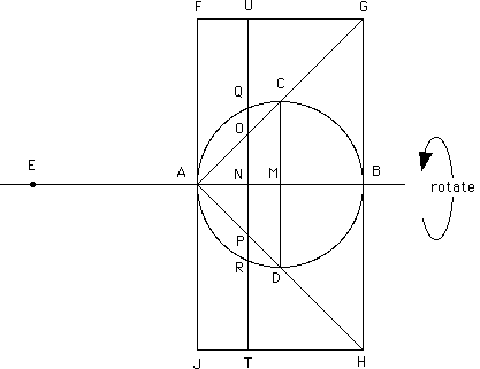
1 A cylinder JHGF (blue), cone AHG (yellow), and sphere ARDBCQ (green) in cross-section. AFGB is a square, and N is an arbitrary point.
Denote the circle with radius XY by C(XY),
square with side XY by S(XY),
rectangle with sides XY, VW by R(XY,VW).
Then
S(ON) + S(NQ) = S(AN) + S(NQ)
= S(AQ) by Pythagoras's Theorem
= R(AN,AB) by standard theorems in circle geometry
= R(ON, NU).
Thus
[S(ON) + S(NQ)]/S(NU) = R(ON, NU)/S(NU) = ON/NU
and correspondingly
[C(ON) + C(NQ)]/C(NU) = ON/NU (*)
since the areas of circles are proportional to the squares on their diameters.
Assume the sphere, cylinder, and cone have equal density, so their masses are proportional to their volumes. Think of AB as the axis of a lever with fulcrum at A, and let E be distance AB to the left. Leave the cross-section C(NU) of the cylinder where it is: hang C(ON) and C(NQ) at E. Then the equation (*) says that they balance. Now do this for all positions of N. That transfers the whole cone AHG, and the whole sphere ARDBCQ, to E, while leaving the cylinder JHGF in place; and everything continues to balance. Now, the centre of gravity of the cylinder is at M by symmetry, so the volumes obey the equation:
cone + sphere = cylinder / 2.
The volume of the cylinder is 8[pi] r3, and that of the cone is one third of this, namely 8/3[pi] r3. So that of the sphere is the difference, which is 4/3[pi] r3, as required.
FURTHER READING
Jacques Hadamard, The Psychology of Invention in the Mathematical Field, Dover Books, New York
Herbert Meschowski, Ways of Thought of Great Mathematicians, Holden Day, New York 1964.
Henri Poincaré, 'Mathematical Creation', in James R. Newman (ed.), The World of Mathematics, Simon and Schuster, New York 1956.
John von Neumann, 'The Mathematician', in James R. Newman (ed.), The World of Mathematics, Simon and Schuster, New York 1956.
Hermann Weyl, 'The Mathematical Way of Thinking', in James R. Newman (ed.), The World of Mathematics, Simon and Schuster, New York 1956.