
21 April 1992
The backcloth depicted a striking scene: the Rhine valley by moonlight. In the pit, the orchestra was rehearsing Wagner's Götterdämmerung. The story had reached the tragic death of Siegfried, and the conductor, Otto Fenderbender, raised his baton for the beginning of the Funeral March. First, just tympani, an intricate repeated rhythm in a low C sharp...
"No, no, no!" screamed Fenderbender, hurling his baton to the floor. "Not like that, you incompetent pigs!"
The leading tympanist, somewhat uniwisely, protested. "But Herr Fenderbender, the rhythm was absolutely pre--- "
"Rhythm, schmythm," said Fenderbender.
"The tempo was exactly as the score indic--- "
"I am not complaining about the tempo!" screamed the conductor.
"The pitch was a perfect C shar--- "
"Pitch? Pitch? Of course the pitch was perfect! I heard that for myself when the orchestra was tuning up! I have extremely precise hearing and an inherently accurate sense of pitch!"
"Then what ---"
"The sound, you fool! The sound!"
The lead tympanist was perplexed. "I didn't hear anything strange about the sound."
"Of course not, you do not have my aural acuity! One of the drums sounded... wrong."
"Wrong, Herr Fenderbender? In what way?"
It was hard to describe. Otto tried to express what he had heard. "It sounded too... well, too square," he said. "The other tympani had their usual... rounded sound; but one of them --- well, it had corners."
"Come now, Herr Fenderbender --- surely you're not claiming you can hear the shape of a drum?"
"I heard what I heard," Otto said doggedly. "One drum is too square."
"He's right," piped up a thin voice from the depths of the orchestra pit. "Mine is."
"What on earth are you waffling about?" asked the lead tympanist.
"My drum's square. Mr. Warthog insisted." Sandy Warthog was the set-designer.
"Why did he do that?" said Fenderbender.
"You'll have to ask him," said the thin voice. "I haven't the foggiest idea." Otto put down his baton in disgust. Set-designers interfering with the music, indeed! "You may all --- er --- take five, while I have a few words with Herr Warthog."
Otto found Warthog in the canteen, drinking a diet soda, and after the shouting had stopped for lack of oxygen, they had a quiet, rational discussion of the problem.
"But Otto, baby, it's absolutely crucial to the whole design concept! If all the drums were the same shape, there would be no variety! All the scenery, all the costumes, all the stage props make a statement about the importance of diversity! That's why half the violins have been painted blue, and three of the trombones have been welded together!"
"I had not noticed," said Otto.
"No, because it didn't affect the sound. You have the most acute hearing in the world, Otto, but you're blind to anything visual."
"But I could hear that the drum was square."
"Yes. That's amazing!"
"It was something about the overtones," said Otto. "Too pure, I think. The overtones on a circular drum have a characteristic lack of harmony. It must be the Bessel functions."
"Pardon?" said Warthog.
Fig.1 A selection of normal modes of a circular drum. Shaded region starts above the plane of the paper, white region below; amplitude varies sinusoidally. Boundaries between regions are nodal lines.There are infinitely many possible normal mode vibrations.
"The nodes of the modes," Otto offered, somewhat obscurely. "I studied musical theory under the great Professor Bravura Banjo-Mandoline and he made me study all the early mathematical writings. When a drum beats, it produces several different notes at once, corresponding to different modes of vibration of the drumskin (Fig.1). Each has its own frequency, that is, pitch. Leonhard Euler calculated the vibrational spectrum of a circular drum --- the range of frequencies of the basic modes --- using mathematical gadgets called Bessel functions. For a square drum you just get sines and cosines. They give characteristic patterns of nodes, where the drum remains stationary (Fig.2).
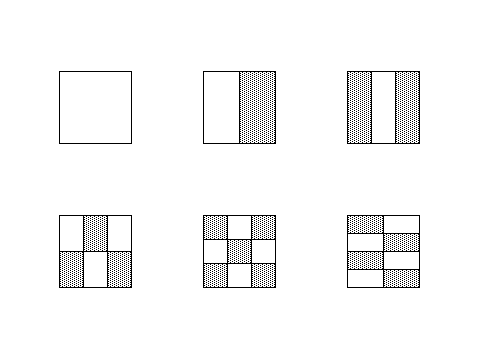
Fig.2 A selection of normal modes of a square drum. Again there are infinitely many possible normal mode vibrations.
"But I do not really care what the vibrational specturm is," Otto continued. "I do not care what sound the drums make, as as long as they all sound exactly alike."
"It's a toughie," said Warthog. "I want at least two different shapes of drum; you want all the drums to have identical spectra. The question is, can two differently shaped drums sound exactly the same?"
"Or, as my lead tympanist asked me a moment ago: can you hear the shape of a drum?"
Warthog sat bolt upright. "Of course! That's a very famous problem in mathematics! It was posed by Mark Kac in 1966."
"And what is the answer?"
"I have no idea," said Warthog. "But I can hire somebody to find out," he added.
"You had better," said Otto. "No sound-alike drums, no Götterdämmerung."
Kac's question is much more important than its quirky formulation might suggest. The frequency of a sound is the number of vibrations per second; the spectrum of any vibrating object is the list of basic frequencies at which it can vibrate. In that language, a more impressive-sounding version of the question would be this: what information about a shape can you infer from its vibrational spectrum? When an earthquake hits, the entire Earth rings like a bell, and seismologists deduce a great deal about the internal structure of our planet from the 'sound' that it produces and the way those sounds echo around, bouncing off different layers of rock. Kac's celebrated question is the simplest and tidiest one that we can ask about such techniques: reconstructing information about an object from the range of vibrations that it can undergo. Kac showed that some features of a drum are determined by its sound: for example its area and its perimeter. "Personally, I believe that one cannot 'hear' the shape... but I may well be wrong and I am not prepared to bet large sums either way," he wrote. The problem is just the tip of a mathematical iceberg, with far-reaching ramifications and generalizations, and more unsolved problems than answers.
Next morning, Warthog reported his findings to Otto over coffee and doughnuts. "I've tracked down an obscure recording that might help," he said. "At a meeting of the American Mathematical Society at Alabama a few years back, Dennis DeTurck of the University of Pennsylvania used a computer to play the Alabama Jubilee as it would sound on a so-called flat torus, and a quartet played upon four different projective spaces (real, complex, quaternionic, and Cayley) --- or equivalently on spheres of dimensions 1, 2, 6, and 12."
"Ah," said Otto. "The harmony of the spheres."
"Not entirely," Warthog replied. "Writing in the Mathematical Intelligencer, Carolyn Gordon remarked that 'The audience would perhaps be happy to learn that flat tori and low-dimensional projective spaces are uniquely determined by their spectra. No two of them produce the same terrible sound.' Subscribers to the Intelligencer were treated to a free record of similar music by DeTurck, including the Romanza movement from Beethoven's Sonatina in G on a 6-dimensional sphere."
"That is all very well, Mr. Warthog," said Otto, "but it hasn't solved the question of the existence of two sound-alike drums."
"Call me Sandy, Otto. No, but it's a start. How're the rehearsals going?"
"Brilliantly. All except the Funeral March, which I refuse to rehearse with a square drum."
Warthog sighed. "Maybe we're looking at this from the wrong end. Kac's question is an 'inverse problem': it runs the opposite way to what you'd expect. The sensible --- and I'm sure far easier --- question is: given the shape of an object, how does it vibrate?"
"Ah, now you are talking my language... Sandy," said Otto. "Let me see... Aha! Violins!"
"No, drums, Otto."
"Shhh. In 1714 Brook Taylor calculated the fundamental vibrational frequency of a violin string in terms of its length, tension, and density. It is [root](T/d)/2l, where T is the tension, d the density, and l the length. But it can also vibrate at higher frequencies: in this case, whole number multiples of the fundamental. You will be aware, of course, Sandy, that the ancient Greeks knew that a vibrating string can produce many different musical notes, depending on the position of the nodes (Fig.3)." For the fundamental frequency, only the end points are at rest. If the string has a node at its centre, then it produces a note one octave higher; and the more nodes there are, the higher the frequency of the note will be. In modern language the Greeks discovered that the vibrational spectrum of the string consists of all whole number multiples of the fundamental frequency. The higher vibrations are called overtones. Taylor's work shows that the length of the string can be deduced from the fundamental frequency, the smallest term of the vibrational spectrum --- provided the tensions and density are already known.

Fig.3 Normal modes of a violin string: fundamental (top) and the first few overtones (below).
"In short, you can hear the length of a violin string," said Otto.
"That's basically a one-dimensional drum," said Warthog. "It's starting to look a bit discouraging, Otto. Good job I decided to paint the violins --- if I'd altered the lengths of the strings, you'd be complaining that they don't sound alike."
The vibrations shown in Fig.3 are standing waves --- the shape of the string at any instant is the same, except that it is stretched or compressed in the direction at right angles to its length. The maximum amount of stretching is the amplitude of the wave, which physically determines how loud the note sounds. The waveforms shown are sinusoidal in shape; and their amplitudes vary sinusoidally with time. 'Pure' standing waves of this type are called normal modes.
"In 1746," Otto continued, "Jean le Rond d'Alembert showed that the full story isn't quite that simple. There are many vibrations of a violin string that are not normal modes, not sinusoidal standing waves."
"What do they look like, then?" asked Warthog.
"Anything you like," said Otto. "Well, you can start with any shape you like, and it will repeat periodically in time. But in between it can change in a very complicated way. Anyway, in response to d'Alembert's work, Leonhard Euler worked out, and solved, the 'wave equation' for a string. These discoveries started a century-long controversy, whose end result was that you get all possible vibrations of the string by superposing normal modes in suitable proportions. The normal modes, the pure sinusoidal standing waves, are the basic components; the vibrations that can occur are all possible sums of constant multiples of finitely or infinitely many normal modes. As Daniel Bernoulli expressed it in 1753: 'all new curves given by d'Alembert and Euler are only combinations of the Taylor vibrations'."
"Did anyone study drums?"
"The first work on drums," said Otto, "was also Euler's, in 1759. Again he derived a wave equation, describing how the displacement of the drumskin in the vertical direction varies over time. Its physical interpretation is that the acceleration of a small piece of the drumskin is proportional to the average tension exerted on it by all nearby parts of the drumskin. Drums differ from violin strings not only in their dimensionality --- a drum is a flat two-dimensional membrane --- but in having a much more interesting boundary."
In this whole subject, boundaries are absolutely crucial. The boundary of a drum can be any closed curve --- usually a smooth one, but nowadays it may well be a fractal. The key condition is that the boundary of the drum is fixed. The rest of the drumhead can move, but its rim is firmly strapped down. This 'boundary condition' greatly restricts the possible motions of the drum. There are boundary conditions on violin strings too: the ends must be fixed. Among other things, those boundary conditions prevent the occurrence of travelling waves, moving sideways along the string.
The mathematicians of the eighteenth century were able to solve the equations for the motion of drums of various shapes. Again they found that all vibrations can be built up from simpler ones, the normal modes, and that those yield a specific list of frequencies. The simplest case is the square drum, whose normal modes are combinations of sinusoidal ripples in the two perpendicular directions (see Fig.2). The same goes for rectangular drums. A more difficult case is the circular drum, whose normal modes involve more complicated expressions, the aforementioned Bessel functions (see Fig.1). The amplitudes of these normal modes still vary sinusoidally with time; but their spatial structure is more complicated.
Over dinner, Warthog and Fenderbender again conferred. "My informant has explained the wave equation to me," said Warthog. "I gather that it's exceedingly important."
"I know that, Sandy," said Otto. "Waves arise not only in musical instruments, but also in the physics of light and sound. Euler found a three-dimensional version of the wave equation, you know. He applied it to sound waves. Roughly a century later, James Clerk Maxwell extracted the same mathematical expression from his equations for electromagnetism, and predicted the existence of radio waves. Without the early mathematicians' work on musical instruments, we would not today have television."
"Oh, wow! That's mindboggling, Otto baby. Now, I have dug up a more precise statement of Kac's question," said Warthog. "Choose a closed curve, defining the boundary of the drum, and imagine a flat membrane stretched between it, of constant density and tension. The possible vibrations of such a membrane are determined by the two-dimensional wave equation, with the condition that the boundary of the drum, the original curve, remains fixed for all time. The solutions of the wave equation are combinations of normal modes, standing waves whose amplitude varies sinusoidally over time. The set of frequencies of the normal modes is the drum's spectrum."
"Yes... and in general it consists of an infinite sequence of numbers n1 d n2 d n3 d ..., the smallest frequency n1 being the fundamental," Otto pointed out. "That was a difficult conjecture, but it was eventually proved."
"Right! Now, Unlike violin strings, the other frequencies need not be integer multiples of the fundamental."
"That, Sandy, is why drums and bells have distinctive sounds --- not entirely consistent with the usual rules of musical harmony."
"Precisely! You know, Otto, we're both on the same wavelength."
"Yes," said Otto sadly. "But you want two drums on different wavelengths, and I do not."
"It'll be OK provided we can come up with two sound-alike drums of different shapes. And I've found some postive evidence! In 1964 John Milnor wrote a one-page paper in which he exhibited two distinct sixteen-dimensional tori with identical vibrational spectra ---"
"What are tori?"
"Generalized doughnuts."
"Amazing. So now I must perform Siegfried's Funeral March with sixteen-dimensional doughnuts instead of tympani. Sandy, it will never work!"
"I'm not suggesting we use doughnuts for drums, Otto. I'm just telling you what I've found out, in case it helps. The first results for ordinary drums were in the opposite direction: various features of the shape can indeed be deduced from the spectrum. The first was the area. There's a rather nice tale attached to that one. Let me pour you another glass of this excellent champagne, and then you can relax while I relate it...
"One of the great mathematical centres around the turn of the century was Göttingen. A wealthy man named P.Wolfskehl endowed a prize for a proof of Fermat's Last Theorem, but in the absence of any solution (the problem is still open but the prize has inflated to nothing) the interest was to be used to pay for a series of lectures. In October 1910 the Dutch physicist Hendrik Lorentz, of Lorentz-Fitzgerald contraction fame, gave the Wolfskehl lectures on 'Old and New Problems of Physics'. His lecture included the following passage:
'There is a mathematical problem which perhaps will arouse the interest of mathematicians who are present. It originates in the radiation theory of Jeans. In an enclosure with a perfectly reflecting surface there can form standing electromagnetic waves analogous to tones of an organ pipe... Jeans asks for the energy in the frequency interval dn. To this end he calculates the number of overtones which lie between the frequencies n and n+dn... It is here that there arises the mathematical problem to prove that the number of sufficiently high overtones which lies between n and n+dn is independent of the shape of the enclosure and is simply proportional to its volume.'
The wave equation for electromagnetism is the same as that for a vibrating solid of the same shape as the enclosure. Lorentz was talking about 'asymptotic' properties of the spectrum, depending only upon very high frequencies; and he was asking whether you can hear the volume of the enclosure if only high frequencies are taken into account." Warthog stopped talking for a moment and sipped at his champagne. "Allegedly David Hilbert --- the Grand Old Man of Göttingen mathematics, I gather --- predicted that Lorentz's question would not be answered within his lifetime. For once he was wrong: less than two years later, Hermann Weyl proved the theorem, for waves in any number of dimensions, using the theory of integral equations --- much of which had been developed by Hilbert!"
Otto emptied his glass. He still looked morose. "Sandy, what am I going to do? I have committed myself to not using your square drum, and we have got to rehearse the Funeral March soon or the whole production will go down the --- er --- tubes!"
"Don't despair, Otto. Something's bound to turn up. Though I'm afraid you'll definitely have to get rid of all the circular drums."
"What? But... why get rid of the only normal shape for a drum?"
"Kac himself proved that for any flat two-dimensional drumskin, the spectrum determines the perimeter. One curious consequence is that you can hear whether or not a drum is circular. A circle has the smallest perimeter for given area. If you know the area A and the perimeter p, and it so happens that p2 = 4[pi]A (as it is for a circle), then the drum is a circle."
"Oh. So when I said that the usual tympani have a nice 'rounded' sound, I was righter than I knew."
"Indeed. Kac also conjectured a formula implying that, should a drum have finitely many holes, then you can hear how many holes there are."
"That is ridiculous! Drums do not work at all if they have holes!"
"No, the edges of the holes are considered to be part of the boundary and hence are also kept fixed."
"Oh."
"My informant has some more positive news for us, too. In 1980 Marie-France Vignéras found new high-dimensional spaces with the same spectra but different topology, proving that a topological invariant called the 'fundamental group' cannot be heard. Other examples were found by A.Ikeda in the same year. In 1985 Toshikazu Sunada found a general criterion for two distinct shapes to have the same spectrum. Using it, Peter Buser, Robert Brooks, and Richard Tse found distinct curved surfaces with the same spectrum. So we could use bells instead of tympani!"
Otto shook his head. "It is a funeral march, Sandy, not a wedding march. Bells! Pah!"
"But if you'd only compromise ---"
"The great Otto Fenderbender never compromises! It is everybody else who has to compromise with me!" The conductor levered himself to his feet. "Warthog: you get your researcher burning the midnight oil. If you have not found the answer by breakfast tomorrow, then I shall cancel the entire performance!"
"But --- the tickets have all beeen sold! You can't..." But he spoke to Otto's retreating back. Warthog sat back in his chair, suddenly sober. "Oh, Lord. Where's my cellphone?" He rushed off.
Next morning, Otto wandered into breakfast early, only to find that Warthog had got there ahead of him.
"Good morning, Otto."
"I doubt it. I have never cancelled a performance of Wagner before --- well, not for such a stupid reason, Warthog --- but I am a man of my word."
"And I of mine," said Warthog. "And I've hit paydirt, Otto! You remember Kac himself said that if he had to guess, then he'd guess that you can't hear the shape of a drum. His instincts were correct! I've just heard that within the last few months Carolyn Gordon and David Webb at Washington University in St. Louis, and Scott Wolpert at the University of Maryland, have constructed two distinct mathematical drumskins that produce the identical range of sounds (Fig.4). Sound-alike drums exist!"

Fig.4 The pound (£) and the yen (¥): Gordon's and Webb's drums. Each is assembled from seven halves of a Maltese cross, and produces exactly the same sound, but their shapes differ.
Otto inspected the sketch. "Weird shapes for drums."
"The whole problem's weird, Otto. No wonder Kac wasn't too sure his guess was right. But the story of the discovery is fascinating. Seems that Gordon was describing one of Buser's examples at a geometry conference in the spring of 1991, and Wolpert, in the audience, noticed that this curved surface possesses a particular symmetry allowing it to be 'flattened' in a natural way. He asked whether the result would answer Kac's original question in the negative. Webb reports the suggestion as being 'like a cold shower', forcing him and Gordon to think the whole problem through again. They became convinced --- wrongly, it later turned out --- that Wolpert's idea wouldn't work, but that something more complicated might. Eventually, having filled their offices with huge paper constructions that wouldn't flatten, they got back on the right track, and came up with the two drums I've shown you, each made from seven bisected Maltese crosses. One drum resembles a pound sign (£), the other (with artistic licence) a yen sign (¥). The pound and yen have identical spectra, but different overall shapes."
"They also have a clear 'family resemblance'," said Otto.
"Yes. They're assembled from identical pieces, and that's important in the proof that the spectra are identical. It involves taking any possible vibration of one drum, cutting along the dotted lines between the seven pieces, and showing that the result can be reassembled to give a valid vibration of the other drum. This technique is based on Sunada's work, and was pioneered by Pierre Bérard of the University of Grenoble."
"In short: solutions of the wave equation can be 'cut-and-pasted' between different drums," said Otto.
"Right! But at any rate, we're in business, Otto baby!" They clinked galsses, and pounded the table together, laughing till the tears rolled down their cheeks. The other diners at breakfast looked askance. Otto's face suddenly fell.
"Sandy, there is still one tiny problem."
"What?"
"How can we possibly take a drum and make a half-Maltese cross?"
Sandy thought for a moment. "Hit him over the head with it?"
FURTHER READING
R.Brooks, Constructing isospectral manifolds, American Mathematical Monthly 95 (1988) 823-839.
Barry Cipra, You can't hear the shape of a drum, Science 255 (1992) 1642-1643.
Carolyn Gordon, When you can't hear the shape of a manifold, Mathematical Intelligencer 11 No. 3 (1989) 39-47.
M.Kac, Can one hear the shape of a drum?, American Mathematical Monthly 73 (1966) 1-23.
J.Milnor, Eigenvalues of the Laplace operator on certain manifolds, Proceedings of the National Academy of Sciences USA 51 (1964) 542.