|
| |
||
Ian Stewart |
||
| Kert Rats meets Red Frawd Physics and maths don't have to be serious. If you read the first instalment of Ian Stewart's Kert Rats you'll discover that maths at any rate can be seriously addicted to really bad puns. And you might learn a bit about physics too. That can't be bad. |
||
| A lecture --- given originally at Gresham College, London on 11 Feb 1998 | ||
| Do Mathematicians Think Logically?
|
MAC@W (Mathematics Awareness Centre at Warwick) Feedback to (Please note that owing to the volume of email Ian Stewart recieves it may not be possible to reply to all messages sent, and in any case replies will be sporadic and may be subject to delay.) or to the editor Wendy (no mail. Out of date mail) |
|
| |
||
David Langford |
||
| What if computers found a use for humanity? | Believe it or not, until recently the editor was a fairly effective technophobe now I find myself moderately technophilic. But what if it is all part of a cunning plan by them. Dave Langford considers whether we are just here to help computers evolve... |
|
| |
||
Wendy Graham |
||
| Tom Holt Interview | Tom Holt has been writing funny books for quite some time. Quite a few of them. He emails funny too - as this interview will show if you read it. | |
| Alastair Reynolds Interview | I enjoyed Revelation Space. It was a big book, literally and figuratively. It had a lot of words and pages, and it encompassed a universe for its story. That is why when, given the chance, I met up with Alastair Reynolds to see who this ESA scientist who writes SF might be, and what makes him tick. This is the result of a couple of hours of chat at the Britannia Hotel in Birmingham, where, incidentally the beer is a modest £1.25 a pint. (These things are important). |
|
| Science of Discworld | Science of Discworld has just reached number two in the Sunday Times best sellers listing. This was all the excuse that editor Wendy Graham needed to find out how Ian Stewart and Jack Cohen teamed up with Terry Pratchett to produce a book which may do more than any other this year to introduce science to the unscientific. |
|
| Solar Spectacular | We just can't ignore it really, can we? With only days to go to what has been called the greatest show in the sky, we had to throw a few bits of info on the solar eclipse at you. Remember - if you miss this one, book early for the next visible in the same places -2070. As with the space station feature, this site will be updated as more information comes in. |
|
| Robet Rankin Interview | Eerie, Indiana
was classed as a children's TV programme. It was one of the most inventive
shows to be made over the last few years. But when it comes to weirdness,
Brentford, Middlesex is not only way ahead. It has been ahead for many years.
Ask Robert Rankin. He should know. He's been telling us about Brentford
weirdness for 19 books. |
|
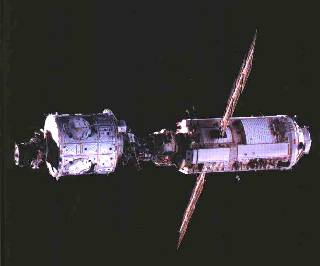
| The station in space. Update July 2000 Update May 2001 |
Most people are vaguely aware that a new space station is being built 'up there'. But, what is it? By whom? What is it for? Wendy Graham takes a look. |
 |
| |
||
Dr John K. Davies |
||
| Is Pluto a Planet? | A long time ago, in a magazine which I mentioned once or twice, one of the contributors was Dr John K Davies. For a long while we lost touch, but I managed to track him down again (thanks internet) and now he is not in Birmingham, but Hawaii - some people have all the luck. He hasn't escaped me though - even from a distance I twisted his arm and he has sent this. | |
| |
||
Neil Christianson |
||
| Cookbook Cosmology I |
Cookbook Cosmology: Earth sciences piqued Neil Christianson's interest in 1972. For years he tried unsuccessfully to define an inner hot-core machine. However, early models defied consistent definition -- all the parts would not mesh. In an attempt to fathom this inconsistency, he set his mind theory free; but held fast to known physical facts. This shifted his quest to the basic constituents of molecular clouds -- where stars and planets are known to grow. Article searches led him to the unique physical characteristics of quantum solid hydrogen, compressed ice and superfluid helium. He blends these characteristics into a working system's definition of a naturally formed heat pump, whose expansion and contraction strokes fit well with surface observations. Christianson's cold-core model was originally introduced in his book, "Earth Has A Cold Heart." |
|
| Cookbook Cosmology II | ||
| Cookbook Cosmology III | ||
| Cookbook Cosmology IV | ||
| Cookbook Cosmology V | ||
| |
||
Home | Editor's Diary | Data Bank | Picture Gallery | Read Out | Features | Products | Events | Communications Bank | Archive
 Features